
Pokies Tips and Tricks: What Players Can Control
 Available in AU

Content
A practical guide to random spins, RTP, session budgets, game volatility and bonus terms, without promising a way to predict outcomes.
What a Pokie Tip Can—and Can’t—Change
When people look for tips to win at pokies, they are often hoping for a useful edge: a pattern to spot, a moment to play, or a way to make a machine more likely to pay. The plain answer is that no playing trick can do that. A tip can help you make clearer decisions about your play, but it cannot change what the next spin will do.
Each spin is random and independent of the spins before it. A run of losses does not make a win due, and a recent payout does not make another payout more likely. The machine has no memory of your last result. It does not know that you have played for a while, raised your bet size, or switched games. Those details may change how you experience the session, but they do not give you information about the next outcome.
That is why timing, lucky charms and betting systems do not improve your chance of winning. Playing at a particular hour does not make a machine more generous. Nor does tapping the screen in a certain way, changing your bet after a loss, or repeating a pattern you believe has worked before. These can feel like actions with meaning because they give you something to do while you wait. They are not signals from the game.
When you’re looking for pokies tips and tricks in 2026, checking an operator’s licensing and practical entry or payout details can help you make a more informed choice. Use these operator notes as a reference point before deciding where to play.
1. LuckyVibe
License: Curacao Gaming Control Board OGL/2023/176/0095 (Hollycorn N.V.)
LuckyVibe is listed with a Curacao Gaming Control Board licence, held by Hollycorn N.V.
2. JeetCity Casino
License: Curacao eGaming (Dama N.V.)
JeetCity Casino is listed with a Curacao eGaming licence, with Dama N.V. named as the licensee.
3. DragonSlots Casino
License: Curacao Gaming Authority (Jumpman Gaming Ltd)
DragonSlots Casino is listed with a Curacao Gaming Authority licence, with Jumpman Gaming Ltd named as the licensee.
4. WinSpirit Casino
License: Curacao eGaming OGL/2024/923/0383 (Antillephone N.V.) · Min. deposit: A$30
WinSpirit Casino is listed with a Curacao eGaming licence issued under OGL/2024/923/0383, and its minimum deposit is A$30.
5. Roby Casino
License: Curacao eGaming (Roby Games Ltd)
Roby Casino is listed with a Curacao eGaming licence, with Roby Games Ltd named as the licensee.
6. Playfina Casino
License: Curacao eGaming (Hollycorn N.V., since 2017) · Min. deposit: A$20-30 (depends on the offer)
Playfina Casino is listed with a Curacao eGaming licence held by Hollycorn N.V. since 2017. Its minimum deposit is A$20–30, depending on the offer.
7. House of Pokies
License: international iGaming licence – jurisdiction not named in the source · Payout speed: PayID 1-24 hours · Min. deposit: A$30 (PayID from A$10)
House of Pokies lists an international iGaming licence, though the source does not name the jurisdiction. You can deposit from A$10 with PayID; the stated minimum deposit is A$30, and PayID payouts take 1–24 hours.
8. 7Bit Casino
License: Curacao, operated by Dama N.V.
7Bit Casino is based in Curacao and operated by Dama N.V.
9. JustCasino
License: Curacao Gaming Control Board
JustCasino is listed with a Curacao Gaming Control Board licence.
10. Ricky Casino
Payout speed: crypto under 1 hour, PayID 1-3 business days · Min. deposit: A$20 (A$30 to qualify for the bonus)
Ricky Casino lists crypto payouts in under an hour and PayID payouts in 1–3 business days. Its minimum deposit is A$20, or A$30 to qualify for the bonus.
The same goes for advice that sounds mathematical. A system might tell you to increase your bet after a loss, or to stop after a win. That can change how much you stake and how long your money lasts, but it does not turn the machine in your favour. If a system asks you to risk more after losing, it can make the cost of a bad run climb faster. A neat sequence is still a sequence of bets on random spins.
There is a useful distinction here: you can manage your choices, not the machine. You can decide whether to play, which game to open, what bet size feels acceptable, and when you have had enough. You can also step away when you notice that you are playing automatically or trying to recover a loss. Those are real ways to put boundaries around the experience. They are not tricks for winning.
I find that distinction more useful than any supposed secret method. It takes the pressure off trying to read meaning into every result. A win is not proof that a tactic worked; a loss is not proof that you chose the wrong moment. Neither tells you what the next spin will bring. That is the whole point of randomness.
Bonus Buy Slots in Australia: How They Work · Seven-Reel Slots in Australia: Rules and Free Play
Every pokie also has a house edge, so its expected value for the player is negative. In plain terms, across repeated play the game is designed to return less than the total amount bet. That does not mean every session ends in a loss: short runs can go either way, and a player can walk away ahead. It means that no strategy makes the overall expectation positive. A lucky result can happen; a reliable method for producing one cannot.
The scale of a large prize helps keep that in perspective. On a $1 poker machine, the odds of winning a typical $5,000 prize are 9,700,000 to 1. That figure is not a forecast for your next spin, and it does not mean a win is impossible. It does show why building a plan around a jackpot is not the same as having a plan that works. The prize is the attention-grabber; the probability is the part worth remembering.
So what should a useful tip promise? Not a way to beat the house. It should help you see what is under your control and what is not. If advice claims a machine is “ready” to pay, says a certain pattern unlocks wins, or presents a lucky time as an advantage, treat the claim with scepticism. The outcomes do not become predictable because someone has given them a confident explanation.
DO
- Manage your own choices and boundaries
- Decide when you have had enough
- Treat claims of “ready to pay” machines with scepticism
DON’T
- Use betting systems to try and beat the house
- Follow patterns you believe have worked before
- Believe that timing or lucky charms improve winning chances
A sensible approach is deliberately less exciting: regard each spin as uncertain, do not chase a loss on the assumption that a win is due, and do not mistake a lucky streak for a repeatable system. If playing stops feeling like entertainment, stopping is a practical decision—not a failed strategy. The machine keeps its odds either way.
Pokies in Australia: The Local Rules and the Word Itself
In Australia, “pokies” is the everyday word for slot machines. You’ll hear it used for machines in pubs and clubs, and people also use it when talking about online slots. The word is local; it does not change what kind of game is being offered or whether the service is lawful.
That distinction matters online. The Interactive Gambling Act 2001 prohibits operators from providing online casino-style games to people in Australia. The category includes slots, poker and table games such as blackjack and roulette. An offshore operator may hold a licence from another jurisdiction, but that licence does not give it permission to provide real-money casino games to customers physically located here.
Real-money casino table games in Australia: rules
A foreign licence and permission under Australian law are not the same thing. A website may display a regulator’s name or badge from Malta, Gibraltar or Curaçao. That may describe its position overseas; it does not turn the service into an Australian-authorised online casino. I would not treat a licence badge as proof that a site can lawfully offer pokies to Australians.
There is also an important difference between the operator’s position and the player’s. The law targets the provision of prohibited interactive gambling services; Australian players do not incur criminal liability simply for accessing an offshore casino. That does not make the operator’s service legal here, nor does it make an offshore licence a local approval. Keep those points separate. They are easy to blur when a site uses familiar Australian language or presents itself as tailored to local players.
The penalties in the Act underline where the legal burden sits: the maximum daily penalty is A$360,000 for an individual who violates it and A$1.8 million for a corporation. Those amounts apply to violations of the Act, not as a fine imposed on a player merely for visiting an offshore gambling site.
5-Reel Slots in Australia: How They Work
What the wording can hide
Online casino sites may describe themselves as “Australian-friendly” or emphasise that Australians can create accounts. Those phrases tell you about a site’s intended audience or its own claims, not whether it is authorised to provide online casino games in Australia. Likewise, an overseas licence should not be mistaken for a licence to operate locally.
A specialist review may report that particular sites hold licences from Malta, Gibraltar or Curaçao. That is a statement about what the review found, not a blanket assurance about every site, a permanent status, or permission under Australian law. Operators and their licensing details can change. More importantly, an offshore regulator’s approval and Australian legality answer different questions.
This is why I would be careful with advice framed as a list of “legal Australian online casinos”. It can make an offshore service sound locally regulated when it is not. Promotional language does not settle the legal position either. A site can accept Australian currency, use local terms or appear in material aimed at Australians without becoming a lawful provider of online casino games here.
Legal Warning
The Interactive Gambling Act 2001 prohibits operators from providing online casino-style games to people in Australia.
The practical takeaway
When someone in Australia says “pokies”, they mean slots. When an online service offers real-money pokies to people physically in Australia, the relevant legal point is that the Act prohibits operators from supplying that kind of casino service here. An overseas licence does not override that rule.
So read claims about “Australian pokies” carefully: the phrase may simply mean online slots marketed to Australian players. It should not be taken to mean that the games are supplied under an Australian online casino licence. The distinction is plain, even when the marketing is not.
What Happens Behind the Reels
The figures behind a pokie describe what happens across a huge number of spins, not what you should expect from a short session. RTP, or Return to Player, is the share of all bets that a game is designed to pay back over millions of spins. It is a long-run measure, not a promise about what comes back to any one player.
For instance, a displayed RTP does not mean the machine will return that share of your money by the end of an evening. Your own results can be far above or below the figure. The percentage only becomes meaningful across the very large volume of play used to calculate the game’s return. That distinction matters: a long-run average can describe a machine accurately while saying little about the next spin.
Pokie Machines to Play in Australia: Legal Guide · Lightning Link Online Pokies in Australia: The Facts
Gaming machines are required to return between 85% and 92% of the money bet over their lifetime. The rest is the built-in margin that allows the machine to retain money over time. That does not mean it keeps a fixed share in every session. Results vary, and a short run may look nothing like the lifetime return.
Random-number technology is the other piece of the picture. It generates outcomes for the game, rather than relying on a visible reel pattern or a machine’s recent history. A certified random-number generator is intended to ensure that outcomes are produced through a tested random process. Licensed gambling sites use RNG technology certified by eCOGRA or GLI. Certification is about the technology and its testing; it does not change the game’s RTP or make a result predictable.
That distinction is easy to lose when a game shows a sequence of near misses, bonus symbols or small wins. The visuals tell a story; they are not a reliable guide to the underlying return. A reel animation is the display of an outcome, not evidence that the next one is due. The same goes for a run of results that feels unusually generous or unusually stingy.
When I look at a pokie, I separate three things: the return figure, the random process producing outcomes, and the presentation on screen. The return figure describes long-run behaviour. The RNG determines outcomes. The graphics and sound make those outcomes feel immediate, but they do not explain what will happen next. Keeping those ideas apart makes claims about a “hot” machine much easier to assess.
Certified random-number generators (RNG) ensure that outcomes are produced through a tested random process, making results unpredictable.
There is no trick in the machinery that turns the advertised return into a personal forecast. RTP is useful for understanding a game’s broad design, while certification speaks to how its outcomes are generated and tested. Neither tells you whether a particular session will finish ahead. That is the practical limit of the numbers.
RTP: Check the Game Screen, Not the Sales Pitch
RTP is useful when you treat it as a comparison figure, not a forecast for your next session. Before choosing a pokie, open its information screen and check the RTP shown there. Don’t rely on a promotional banner or a figure copied from a review: the value displayed for the game is the one to assess.
A higher RTP means a smaller theoretical share of total bets is retained by the game over the long run. As a starting point when comparing options, look for RTP above 96%. That does not make a pokie profitable, and it does not tell you what will happen in a short run of spins. A high figure is a relative measure, not a promise.
The distinction matters because RTP describes results across a very large number of spins. One specialist review reported a median RTP of 96.2% across 6,847 observed sessions, compared with the games’ declared values. That is a finding from that review, not a universal figure for every pokie or a prediction for your own play. A session’s observed return can sit well above or below a declared RTP; a small run of results cannot confirm that the game is paying at its long-run rate.
High-Volatility Slots in Australia: How They Work · Casino Dice Games in Australia: Rules and Legal Context
For a rough planning estimate, use:
Expected loss = bet size × number of spins × (1 − RTP)
Put the RTP into the formula as a decimal. If the checked game-screen value is 96.2%, the calculation uses 0.962, leaving 0.038 as the theoretical loss share. Multiply that share by your total bets to estimate expected loss over the chosen number of spins. This is a long-run estimate, not an amount you are certain to lose in one session: your actual result may be a win or a larger loss.
The formula also shows why bet size and spin count matter to the estimate. More total bets increase the theoretical expected loss, even if the RTP stays the same. That does not mean you can predict the result of the next spin, or that a particular session will match the estimate. It is a planning tool, not a scoreboard.
You may see the phrase “RTP Threshold Strategy” used for choosing games above a particular RTP. The limited point is that a higher RTP reduces the theoretical house edge per spin compared with a lower-RTP game. It does not remove that edge or create a winning system. In practical terms, you can compare the figure, but you cannot use it to turn uncertain short-term results into a reliable outcome.
When I check a pokie, I read the information screen first, then treat the percentage as a long-run comparison. If the displayed value is unclear, don’t fill the gap with a sales claim. No clever reading of RTP can make the next result knowable.
RTP Limits
High RTP is a long-run comparison tool, not a guarantee of a winning session.
Playing Dragon Link Without Chasing a Jackpot
Dragon Link’s jackpot is an obvious thing to focus on: it gives the game a clear headline and a tempting target. But treating that prize as a plan is a poor way to approach a session. A jackpot is a possible outcome, not a dependable source of returns, and no playing pattern can make it arrive on schedule.
That distinction matters if you are looking for tips on playing Dragon Link. A useful tip can help you decide whether the game fits the kind of entertainment you want. It cannot turn a progressive jackpot into a predictable result. I would treat the jackpot as part of the game’s appeal, not as a reason to keep playing until it pays.
A specialist review’s Vault framework advises against making progressive-jackpot pokies a regular part of your play. That is a useful caution, not a promise that avoiding them will produce a better result elsewhere. The point is simpler: repeated play aimed at a large prize can encourage you to keep going for an outcome you cannot control. The prize can remain out of reach, while your spending continues.
If you enjoy Dragon Link, decide what you enjoy about it before you start. Is it the theme, the pace, or the possibility of seeing the jackpot feature? Being honest about that can help you notice when the entertainment has shifted into chasing. If the only satisfying outcome is the jackpot, an ordinary session may feel like a failure, even when you knew the prize was uncertain going in.
Mines Casino Game in Australia: What to Check
I’d also avoid reading meaning into a jackpot that seems close, or into a run of results that feels as though it ought to lead somewhere. Those impressions can make another spin feel justified, but they do not give you a reliable signal about what comes next. “Nearly” is not a plan.
For Dragon Link, the sensible approach is therefore not a secret sequence or a special bet pattern. It is deciding whether you are comfortable playing a progressive-jackpot game without expecting its headline prize. If that expectation makes the game less appealing, that is useful information. You do not owe a machine another spin because a feature has not appeared.
A jackpot-focused session can also crowd out the reason you sat down to play: a bit of entertainment, within limits you have chosen for yourself. When the prize becomes the whole point, it is easy to judge every spin by whether it moved you closer to it. It did not. The attraction is real; the plan is not.
So, if you choose Dragon Link, keep the jackpot in the “might happen” column. Enjoy the game only on terms that still make sense if it never appears. That is less exciting than a winning system, naturally. It is also more honest.
Set a Session Budget Before You Spin
Before I start a session, I decide what I can spend and treat that amount as the cost of the entertainment. It is not money I expect to win back, and it does not include cash needed for bills, food or anything else I have already planned to pay for. That line matters more than any supposed tip for winning at the pokies.
Expected Loss Calculation
Step 1: Identify variables
Determine your bet size, the number of spins, and the game’s RTP (as a decimal).
Step 2: Apply the formula
Use the formula: bet size × number of spins × (1 − RTP).
Step 3: Interpret the result
Use this figure as a long-run planning estimate, not a certain amount you will lose in one session.
A useful way to connect a budget to play is the expected-loss formula:
Expected loss = bet size × number of spins × (1 − RTP)
It is a planning estimate, not a forecast of what your own session will do. The calculation describes an average across many spins. Your actual result can be higher or lower, and a short session may bear little resemblance to that average. Still, the formula shows why bet size and the number of spins matter when you are deciding how much play a fixed budget can support.
Think of your budget as a hard ceiling, not a target you have to use up. Choose a bet size and a rough session length that fit within it; if the estimate looks uncomfortable, adjust the plan before starting. A smaller bet can reduce the expected loss per spin, while more spins give that loss more opportunities to accumulate. Neither choice changes a spin into a better chance of winning.
That is the useful part of the calculation. It turns a vague feeling of “I’ll see how I go” into a decision you can make while you are still clear-headed. I would rather set the limit at the start than negotiate with myself after a losing run. The machine is not keeping track of what I have already spent, and a previous loss gives no reason to expect the next spin to repay it.
Live Blackjack Online in Australia: Rules and Limits
I also avoid treating a win as permission to raise the budget. If you decide in advance that your limit is the amount you are prepared to lose, a lucky stretch does not need to rewrite the plan. You can stop with a win, stop with a loss, or stop when the time you set aside is over. The point is that the decision is yours, not a response to the last few spins.
If the budget is gone, the session is over. Don’t borrow from another spending category, add more money because you are close to getting even, or tell yourself that one more round will fix the result. Those are ways of changing the limit after the very conditions that made it useful have arrived.
A fixed budget cannot make pokies profitable or guarantee a particular result. It can help keep a session within bounds you chose beforehand. That is a more honest aim than chasing a winning system—and a much better reason to plan before you spin.
A Few Practical Checks Before You Play
A sensible check is whether the controls are easy to find before play begins. Look for deposit limits and session timers in the account or play settings, and see whether they can be set before you start. A control buried several menus deep is less useful in the moment than one you can reach without hunting around.
Practical Checks
- Check for available deposit limits
- Set a session timer
- Verify that limits and timers are active
- Ensure the interface allows you to pause cleanly
Deposit limits let you restrict how much you can add. A session timer gives you a prompt to stop and check how long you have been playing. Neither changes the game’s outcomes; they add friction between an impulse and another spin. I’d treat them as practical guardrails, not as a way to make gambling risk-free.
Pay attention to what happens when you use a phone. Swiping to spin and moving straight from one result to the next can make play feel almost continuous. A specialist review of mobile play has noted that this lower friction can raise the number of spins in a session, speeding up the rate of theoretical losses. The game has not changed; the pace has. Easy to miss.
That is why I would check whether the interface lets you pause cleanly, whether the timer remains visible, and whether you can leave the game without being nudged straight back into another spin. If notifications or repeated prompts make it harder to stop, switch them off or close the session. A quieter screen can help you notice your own choices.
It is also worth checking that the limits and timer are active, rather than assuming a setting has been saved. If a control is confusing, unavailable or difficult to change, do not rely on it as a safeguard. You can step away instead. The most useful interface is one that makes stopping straightforward, not one that keeps the next spin under your thumb.
These checks are about pace and control, not a method for improving your chances. In Australia, real-money online casino games are prohibited services for operators to provide to people here. Keep that distinction in mind when assessing any gambling interface; a visible timer or limit does not make an unlawful service lawful. If gambling is becoming difficult to control, Gambling Help Online offers support at https://www.gamblinghelp.gov.au.
Video Slots in Australia: Rules, RTP and Free Spins
Keep Free Spins in the Fun-Play Column
A demo mode is a low-pressure way to see how a pokie works without staking real money. You can get a feel for its layout, features and pace, then decide whether you even enjoy it. Treat the play as a preview, not a rehearsal that can tell you what a real-money session will bring.
Free spins need a different kind of check. They may sound like a no-cost extra, but any winnings can be subject to wagering requirements before they can be withdrawn. A specialist review reports requirements of 20–40x for free-spin winnings; that is a reported range, not a rule for every offer. Read the specific terms before accepting or using spins.
Look for what the requirement applies to: the winnings, a bonus balance, or another stated amount. Check which games count towards it and whether there are conditions on withdrawing. If the terms are unclear, leave the offer alone. The word “free” does not do the reading for you.
I’d keep the two options in separate mental boxes. Demo play is for trying a game without risking a deposit. Free spins are an offer with conditions attached, even when you have not paid directly for each spin. Neither is a way to make a profit dependable.
If you want a bit of entertainment, a demo can be enough. If you choose to use free spins, take a moment to read their terms first and stop if the conditions do not suit you. Less fuss.
Free Spins Terms
Always read the specific wagering requirements attached to free spins, as winnings may be subject to terms before they can be withdrawn.
Five Dragons: Check the Volatility Before You Choose
If you’re looking up Five Dragons, don’t assume the name tells you how the game behaves. I wouldn’t attach a volatility rating or a particular RTP to it without checking the game’s own information screen. Those details matter more than the theme when you’re deciding whether a pokie suits a limited session budget.
Volatility is about the pattern of wins, not a promise about what your next spins will do. A lower-volatility game may pay smaller wins more frequently; a higher-volatility one may have longer stretches without a win. Neither pattern makes an overall profit more likely. A run of small payouts can also leave you down, even if the session feels active.
For a limited budget, a game with high RTP and low volatility may produce more frequent small wins and make the balance last longer. That can extend your session, but it doesn’t improve your odds of finishing ahead. More time at the reels is not a winning system. It simply means more play.
Before choosing, look at the RTP and volatility information provided for that specific game. Don’t rely on a label from a review or assume that every version has identical settings. If you can’t find clear game information, skip the guesswork and choose something whose details you can verify.
For Five Dragons, the sensible tip is not a special betting pattern or a way to trigger a feature. It’s to judge the game by its published information, then decide whether its risk pattern fits the amount you’re prepared to spend. A familiar title can still be the wrong fit for a short, tightly budgeted session.
Small wins are still not a safety net. Keep the distinction clear: volatility describes how results may be distributed over time; it does not predict your session’s outcome.
3-Reel Slots in Australia: Features, RTP and Play
Read the Bonus Terms Before You Start
A bonus can come with a substantial wagering requirement, so read the conditions before accepting it. The multiple tells you how many times the bonus amount must be wagered before the requirement is complete. It does not mean you can withdraw the bonus straight away, and it does not make the play profitable.
A specialist review illustrates the arithmetic with a A$100 bonus carrying a 30x requirement: A$100 multiplied by 30 means A$3,000 in total bets. That is turnover, not an amount you need to deposit or a promise that you will have A$3,000 available. Your balance can rise or fall as you play, and the terms determine which bets count and what happens to any winnings.
Check the active-bonus bet cap just as carefully. A specialist review describes per-spin limits in the A$5–A$10 range at many Australian-friendly casinos, but the rule for a particular offer is the one written in its terms. For a cautious approach, do not exceed A$5 on any spin while the bonus is active. Some terms say that going over the permitted amount can forfeit the bonus or related winnings. One larger spin can undo a lot of careful reading.
Look for the maximum bet, which games contribute to wagering, excluded games, expiry conditions and any withdrawal restrictions. If a condition is unclear, ask the operator for clarification before you opt in; do not rely on a banner or a summary that leaves out the detail. Keep a copy of the terms that applied when you accepted the offer.
The useful tip is simple: treat the bonus as a set of conditions, not extra cash with no strings attached. If the wagering target or bet cap does not suit how you planned to play, decline it. A clean decision before the first spin is easier than sorting out a disputed balance afterwards.
Can I play pokies for free?
Yes. All recommended sites offer demo modes, so you can try pokies without wagering real money.
Are RNG outcomes truly random?
Yes. Each spin is random and independent of previous results, and licensed sites use eCOGRA- or GLI-certified RNG technology.
How often should I update my strategy based on results?
You should not change your approach based on wins or losses: past spins do not predict the next one, and no strategy can overcome the house edge.
Are progressive jackpot pokies worth playing under the Vault’s framework?
No. The Vault framework advises against playing progressive jackpot pokies regularly.
Related posts
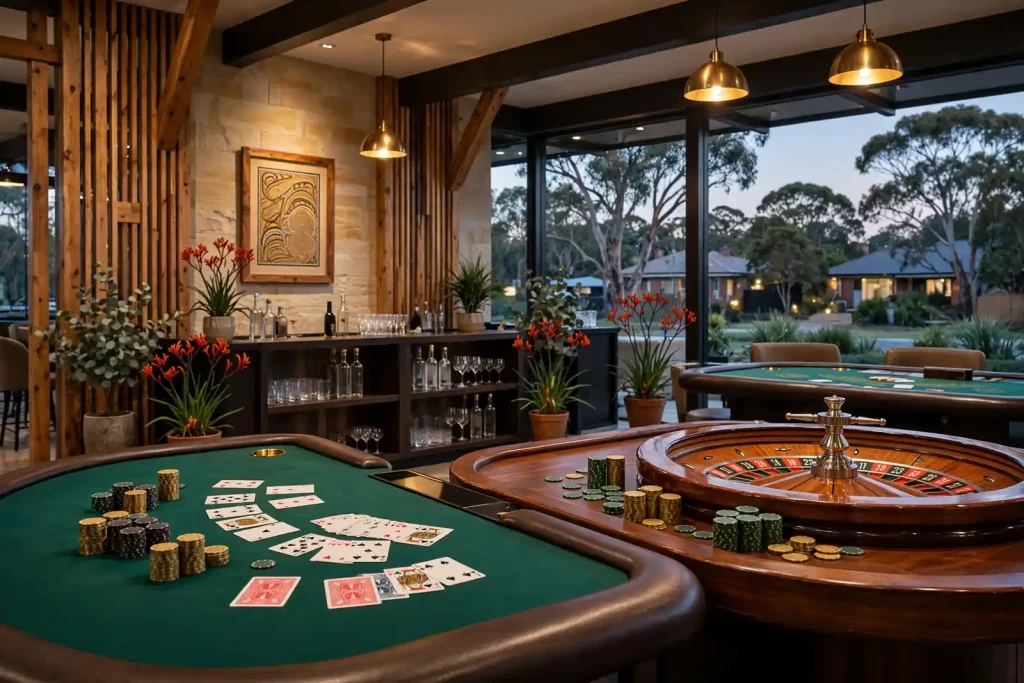
Real-money casino table games in Australia: rules

Plinko Casinos in Australia: RTP, Rules and Payments