
Low-Volatility Slots in Australia: What to Know
 Available in AU

Content
Low-volatility games may pay smaller amounts more often, but neither the pattern nor a paytable predicts an individual spin.
What Low Volatility Means on a Slot’s Paytable
When people talk about a low-volatility pokie, they mean a game where wins tend to arrive more often and are generally smaller, with less fluctuation in winnings. The useful idea is the pattern, not the label: results may feel steadier because the game returns smaller amounts more frequently rather than leaving long gaps between wins. That does not make any individual spin predictable.
I find it easiest to separate two things that can look similar on screen: how often a win appears, and how much that win pays. A game can show plenty of winning spins without returning a large amount each time. That pattern is what people have in mind when they talk about low volatility. The win animation may be satisfying; the amount credited is a separate matter.
What the paytable can—and cannot—tell you
A paytable lists the game’s symbols and the prizes attached to winning combinations. It gives you a way to understand what different outcomes are worth under the game’s rules. It does not, by itself, tell you exactly how often each outcome will appear or establish a volatility category. Reading it is useful, but it is not the same as having a complete picture of the game’s results.
Low-volatility slots may suit you if you prefer steadier, less swingy play, but volatility alone cannot guarantee a particular result. Use this list as a starting point and check each casino’s terms before you play.
1. LuckyVibe
License: Curacao Gaming Control Board OGL/2023/176/0095 (Hollycorn N.V.)
LuckyVibe is listed with a Curacao Gaming Control Board licence, OGL/2023/176/0095, held by Hollycorn N.V.
2. JeetCity Casino
License: Curacao eGaming (Dama N.V.)
JeetCity Casino is listed with a Curacao eGaming licence held by Dama N.V.
3. DragonSlots Casino
License: Curacao Gaming Authority (Jumpman Gaming Ltd)
DragonSlots Casino is listed with a Curacao Gaming Authority licence held by Jumpman Gaming Ltd.
4. WinSpirit Casino
License: Curacao eGaming OGL/2024/923/0383 (Antillephone N.V.) · Min. deposit: A$30
WinSpirit Casino is listed with a Curacao eGaming licence, OGL/2024/923/0383, held by Antillephone N.V. Its minimum deposit is A$30.
5. Roby Casino
License: Curacao eGaming (Roby Games Ltd)
Roby Casino is listed with a Curacao eGaming licence held by Roby Games Ltd.
6. Playfina Casino
License: Curacao eGaming (Hollycorn N.V., since 2017) · Min. deposit: A$20-30 (depends on the offer)
Playfina Casino is listed with a Curacao eGaming licence held by Hollycorn N.V. since 2017. Its minimum deposit is A$20–30, depending on the offer.
7. House of Pokies
License: international iGaming licence – jurisdiction not named in the source · Payout speed: PayID 1-24 hours · Min. deposit: A$30 (PayID from A$10)
House of Pokies has an international iGaming licence, though the source does not name the jurisdiction. PayID payouts are listed at 1–24 hours; the minimum deposit is A$30, or A$10 with PayID.
8. 7Bit Casino
License: Curacao, operated by Dama N.V.
7Bit Casino is listed as operated by Dama N.V. under a Curacao licence.
9. JustCasino
License: Curacao Gaming Control Board
JustCasino is listed with a Curacao Gaming Control Board licence.
10. Ricky Casino
Payout speed: crypto under 1 hour, PayID 1-3 business days · Min. deposit: A$20 (A$30 to qualify for the bonus)
Ricky Casino lists crypto payouts under 1 hour and PayID payouts in 1–3 business days. Its minimum deposit is A$20, or A$30 to qualify for the bonus.
That distinction matters because a paytable can make a game look generous at a glance. Several combinations might pay something, while the amounts attached to them remain modest. Seeing many possible wins listed does not show that those wins occur at the same rate, or that any particular session will include them. A list of prizes is not a promise of a pattern.
Volatility describes the shape of results over play, rather than the value of one symbol combination in isolation. In a low-volatility game, the general pattern is frequent, smaller wins and less movement in the running balance. The word “general” is doing real work here: it describes a tendency, not a schedule. A run of spins can still feel uneven, and no single result proves what the next one will be.
Frequency is not the same as value
A frequent win is not automatically a profitable one. A spin may return a small amount, yet that amount may not cover the stake used for the spin. The screen can register a win while the balance still falls. That is why it helps to notice both the appearance of a win and its actual effect on the amount you have left.
For instance, imagine looking at a sequence of results rather than one spin. If small returns appear regularly, that may fit the low-volatility pattern. But you would still need to consider how those returns compare with the stakes and what happens across the sequence. Counting winning animations alone leaves out the part that matters to your balance.
Bonus Buy Slots in Australia: How They Work · Mines Casino Game in Australia: What to Check
This is an easy point to miss because games put the event in the foreground. Lights flash, a sound plays, and the game marks the result as a win. Your balance is quieter. I would keep an eye on that number too. A visible win tells you that a winning combination occurred; it does not, on its own, tell you that you came out ahead.
A clue, not a verdict
Frequent small wins may be a clue that a game has low volatility. They are not proof. A short stretch of play can give a misleading impression: small wins may arrive close together, or they may not show up for a while. Either way, a brief sequence cannot turn chance into certainty.
That is why I would avoid deciding a game’s volatility from a handful of spins. What you see in a short session is a limited sample of results, not a reliable description of every outcome the game can produce. A pattern may become more noticeable over extended play, but even then it does not mean the next spin is due a win or that the game will follow a tidy rhythm.
Nor does the word “low” mean “no risk”. It refers to less fluctuation in winnings and a tendency towards smaller wins appearing more often. It does not mean that every spin pays, that losses disappear, or that the balance will move only in one direction. A smoother-feeling pattern can still include losing spins. That is the part the label does not soften.
Risk of Loss
Gambling involves risk, and you can lose money. A smoother-feeling pattern can still include losing spins.
When I hear someone describe a pokie as low volatility, I take it as a description of the kind of result pattern they expect, not a promise about what a player will experience. The game may produce regular small returns, but the timing and outcome of any particular play remain uncertain. Even a label presented confidently should not be read as a guarantee of frequent wins during your own session.
Why the label can feel different from play
People often judge volatility by feel. A game with smaller, more frequent returns may seem less abrupt than one whose results swing more noticeably. But personal impressions are shaped by the particular sequence someone has just seen. One player’s short session may seem steady; another’s may not. Neither experience alone settles the game’s underlying pattern.
There is also a difference between “I saw several small wins” and “this game is low volatility”. The first is an observation. The second is a broader description of how results are characterised. Keeping those statements separate makes it easier to read claims without treating a run of good-looking outcomes as evidence of a guaranteed pattern.
The same caution applies when you inspect a paytable. A range of small prizes can look consistent with low volatility, but prize size alone does not tell you how regularly those prizes occur. Likewise, a large prize shown in the paytable does not, by itself, explain the game’s overall volatility. The paytable answers what a listed combination pays; it is not a forecast of when that combination will appear.
Video Slots in Australia: Rules, RTP and Free Spins · Live Blackjack Online in Australia: Rules and Limits
So, what does low volatility mean in slots? In plain terms, it describes games associated with smaller wins arriving more frequently and less fluctuation in winnings. If small wins keep appearing, that may point in the same direction, but it remains a clue rather than a firm conclusion. The cleanest way to hold the idea in your head is to treat volatility as a broad description of results, not a promise about your next spin.
Steadier, not certain.
Low Versus High Volatility: Hit Frequency and Payout Size
Volatility describes the pattern of a pokie’s payouts, not whether it will return more money overall. A low-volatility game is associated with smaller wins arriving more often. A high-volatility game is more uneven: wins may come less regularly, while the possible payouts can be larger. Those are broad profiles, not promises about what any particular spin will do.
That distinction matters because a run of small wins can feel very different from a long stretch without a return. With low volatility, the balance may move in smaller steps. High volatility can bring sharper changes: a quiet patch may be followed by a larger payout, or it may not. The possibility of a bigger win is not a forecast. No volatility setting removes uncertainty.
Low Volatility
Associated with smaller wins arriving more often and less fluctuation.
High Volatility
More uneven with less regular wins and the possibility of larger payouts.
Frequency and size are different trade-offs
Low-variance games tend to return smaller amounts more frequently, which can stretch a bankroll compared with a game whose payouts are more sharply concentrated. “Stretch” is the important word; it does not mean that the balance is protected or that losses cannot accumulate. Small returns may only offset part of what has been staked.
The trade-off is that low-volatility pokies may offer smaller jackpots and payouts than other games. A player who values a steadier pattern may find that profile easier to follow, while someone drawn to the chance of a larger payout may prefer the less predictable pattern associated with high volatility. Neither preference changes the underlying uncertainty, and neither profile guarantees a profitable session.
It helps to think of hit frequency and payout size as separate parts of the picture. A game can produce frequent small returns without delivering a large payout. Another may go longer between returns but have the potential for a larger one. Frequency alone does not tell you the value of a return, and a large possible prize does not tell you how likely it is to appear.
That is why “high volatility versus low volatility” is not a simple ranking from worse to better. It is a comparison of how results may be distributed. Low volatility usually points towards smaller, more frequent payouts; high volatility points towards greater swings and the possibility of larger payouts. Neither description tells you what will happen during a particular session.
3-Reel Slots in Australia: Features, RTP and Play · Live Roulette in Australia with English-Speaking Dealers
Volatility is not the same as RTP
RTP and volatility answer different questions. RTP describes a game’s theoretical return over extended play, while volatility concerns the pattern of wins and losses along the way. A high RTP does not, by itself, mean a game has low volatility. Nor does a low-volatility label establish that its RTP is high.
So, when you see a claim about a high-RTP, low-volatility game, read the two parts separately. One is about the stated return figure; the other is about payout variation. Treating them as interchangeable can create a misleading impression of steadiness or value. A theoretical return is not a personal forecast, and it cannot promise that your own results will follow that figure.
The same applies when comparing low-volatility RTP claims across games. The RTP figure does not settle which one will feel steadier, and volatility does not establish which one has the higher RTP. A comparison needs both pieces of information, clearly identified, rather than a label that bundles them together.
In plain terms, a low-volatility profile may mean more frequent small returns, with smaller potential jackpots than some alternatives. A high-volatility profile may involve more pronounced quiet spells and the possibility of larger payouts. “May” matters here. These are tendencies, not schedules; a game does not owe you a win because several spins have passed without one.
If you are comparing the two profiles, focus on the experience each describes rather than treating either as a shortcut to a better outcome. Low volatility can feel less jagged; high volatility can feel more dramatic. The smaller, more frequent returns of the first profile may help a bankroll last longer, but they do not guarantee that it will. The larger potential payouts associated with the second do not make a big win more certain.
Do
- Set a budget before you begin
- Decide on an end point for your session
- Check the game’s RTP in the information panel
Don’t
- Increase stakes to chase losses
- Use gambling to escape problems
- Assume a low-volatility label guarantees wins
Different rhythm. Same uncertainty.
How to Think About Low-Volatility Play in 2026
A lower-volatility game may make a session feel steadier, but that is not the same as making it safe or profitable. If you are weighing this style of play, start with the money and time you can afford to lose—not with the hope that a particular game will make a session last.
The practical appeal is straightforward: low-volatility games can support longer sessions with reduced risk compared with more volatile play. That describes a relative difference, not protection from loss. A longer session still means more time exposed to gambling, and no volatility setting can ensure that your balance will hold or grow.
I’d treat “low volatility” as one factor in a decision, not a verdict about whether a game suits you. Ask yourself what you want from a session and what outcome you could comfortably accept. If losing the amount you have set aside would affect bills, savings or plans, that money is not a session budget. Leave it alone.
A useful budget is one you decide on before gambling and can stick to without borrowing or dipping into money meant for something else. Decide in advance when you will stop, too. That gives you a boundary to follow if the session feels different from what you expected. If you find yourself changing the limit to recover losses or keep playing, stop rather than treating the change as a new plan.
Pokies Tips and Tricks: What Players Can Control
Time matters as well as money. A game that allows a longer session can make it easy to lose track of how long you have been playing. Set an end point before you begin and take a break when it arrives. If you are tired, stressed or using gambling to escape a problem, postponing the session is the more sensible call. It is easier to make a clear decision before the game has your attention.
Don’t confuse a calmer pace with a reliable return. A lower-volatility label does not promise that you will win, prevent losses from adding up, or tell you how a particular session will go. Think of it as a description of the game’s general risk profile, not a forecast for your balance. The sensible match is between that profile, your own tolerance for uncertainty and a budget you can afford to lose.
I would also be wary of using a game’s feel as a reason to extend a session. A run that seems comfortable is not a signal that you should add funds, and a run that goes badly is not a reason to chase what you have lost. Either way, adding money changes the amount at risk; it does not make the next outcome more favourable.
Because this is a sensitive area, keep the legal setting in mind rather than treating availability as approval. This discussion is not an invitation to access an online casino. Gambling involves risk, and you can lose money. Online gambling content is for adults aged 18 and over.
Legal Note
The Interactive Gambling Act 2001 restricts operators from providing real-money online casino games to people in Australia.
This page is affiliate-driven and may include sponsored links. That commercial relationship is not an endorsement or a recommendation to gamble, and it does not change the risks described here. If gambling is causing you harm or feels difficult to control, step away and seek support rather than trying to solve it by changing games or budgets.
Online Pokies and the Australian Legal Position
The Australian legal position draws a line between the people who provide online casino games and the people who might access them. Under the Interactive Gambling Act 2001, operators cannot provide real-money online casino games to people in Australia. That covers pokies as well as online poker and table games. The restriction is on the service being offered to customers here; it does not make an Australian resident’s act of playing at an offshore casino that accepts them a criminal offence.
That distinction matters, but it is not an endorsement of offshore gambling or a guarantee that a site will remain available. A service may accept Australian visitors and still fall within the category of prohibited interactive gambling services. The law’s focus is on the operator’s conduct in supplying the service, rather than imposing a personal penalty on a resident simply for playing there.
ACMA, the Australian Communications and Media Authority, is the federal regulator responsible for enforcing the Act and monitoring compliance with interactive gambling laws. Its role includes taking action when a service is considered prohibited. One tool available to the authority is asking Australian internet service providers to block access to websites that provide prohibited gambling services or advertise them in Australia.
5-Reel Slots in Australia: How They Work · Plinko Casinos in Australia: RTP, Rules and Payments
A block is an enforcement measure, not a sign that a website has been approved or assessed as safe for customers. Nor does a site’s continued availability establish that it complies with Australian law. Access can change after enforcement action, and the regulator’s work includes addressing both gambling services and affiliate websites associated with them.
ACMA reports that, following enforcement activity, it has blocked more than 1,455 illegal gambling and affiliate websites since November 2019. Reports also differ on the number of illegal services that have left the Australian market since enforcement began in 2017: one figure says more than 210, while another gives a total of over 190. Those figures are not the same, so it would be misleading to present either as an undisputed count.
For anyone reading about low-volatility pokies or comparing descriptions of online games, the legal context is separate from the game’s volatility. A label describing frequent, smaller returns does not change whether an operator may legally provide the game to people in Australia. The same applies to claims about the best low-volatility online slots: a game description is not a legal status check, and an offshore site’s willingness to accept a customer does not turn its service into an authorised Australian casino.
I would keep those questions distinct. If you are trying to understand whether a game is low volatility, that is a question about its play pattern. If you are asking whether an operator can supply online casino games to Australians, the Act and ACMA’s enforcement activity are the relevant context. Don’t muddle the two.
Before You Play
- Decide on a budget you can afford to lose
- Set a time limit for your session
- Check the game’s RTP and volatility profile
- Verify the bet covers the intended amount across all lines
This page is affiliate-driven and may contain sponsored links. That disclosure does not change the legal position or amount to a recommendation to use an offshore casino. Gambling carries a risk of losing money. Online gambling content is for people aged 18 and over.
Casino Context: Smaller Wins, Longer Sessions, and the Catch
Smaller, more frequent returns can make a session feel as though it is lasting longer. When some of what you stake comes back in modest amounts, your balance may decline more slowly than it would during a run of losses. That can stretch the time you spend playing, but it is not the same as making a profit. A balance that lasts longer can still fall to zero.
That distinction is easy to lose in the moment. A return is not necessarily a net gain: what matters is how it compares with the amount you have put in over the session. Frequent small wins can feel reassuring, yet they do not show that the next spin will return anything or that the overall session will end ahead. The label “low volatility” is no promise of a safe outcome.
There is also a less comfortable side to a longer session. A specialist review has reported that frequent wins may lead players to add more funds to their casino accounts. That is a reported risk, not a rule about every player or every game. Still, it is worth noticing how the pattern can work: a small return may feel like a reason to keep going, while extra deposits quietly increase the amount at stake. The session is longer. The exposure is larger.
Seven-Reel Slots in Australia: Rules and Free Play
I’d set a stopping point before playing and treat any money added after that as a decision to spend more, not as a way to recover what has gone. If you find yourself depositing because a run of small returns has made a win seem due, step away instead. No payout pattern can promise that the next result will make up for earlier losses. Small wins are still wins; they are not a plan.
Gambling carries a risk of losing money, and you should only engage with it if you are at least 18. This page is affiliate-driven and includes sponsored links; that commercial relationship does not change the risks or make any gambling service suitable for you. I would not use the prospect of a longer session as a reason to spend more. A longer session can simply mean more time exposed to losses.
Checking Volatility Claims in Pragmatic Play Games
A Pragmatic Play label tells you who made a game; it does not, by itself, tell you how volatile that game is. Games from one provider can have different play patterns, so treating the provider name as a volatility rating is a shaky shortcut. The same applies to a game’s theme or visual style: neither proves how its results behave.
If you are trying to identify lower-volatility games from Pragmatic Play, look for information about the individual game rather than relying on the studio name. A label or description may be a useful lead, but it is not confirmation on its own. Be cautious with unsupported claims that every game from one provider belongs in the same volatility category.
Summary
- Volatility describes the pattern of wins, not the total return.
- Frequent small wins are a clue, not a guarantee of profit.
- Always check the specific RTP for the version of the game you are playing.
Demo mode can help you explore how different games feel without placing real-money bets. You can observe the play over time and compare games, while remembering that a short run cannot establish a dependable pattern. Results vary, and a few frequent small wins do not prove that a game is low volatility. Treat demo play as a way to familiarise yourself with a game, not as a forecast of what would happen in other conditions.
That distinction matters when you see broad claims about “low volatility Pragmatic slots”. The wording may sound precise, but it says little unless it refers to a particular game and is supported by relevant game information. A provider’s reputation, a familiar design, or a label repeated across a page is no substitute for checking the game itself.
This page is affiliate-driven and includes sponsored links. That disclosure does not turn a provider label into evidence, nor should it be taken as a recommendation to play. Online gambling carries a risk of losing money. For a cautious assessment, separate what a game’s information actually states from what a promotional description suggests. Short version: check the game, not the badge.
Bet Size and Paylines: Keep Each Spin in Perspective
Paylines can make a spin feel busy: several lines may be active at once, and the stake applies across the setup shown on screen. Before considering any spin, check what the displayed bet covers. A number that looks small in one part of the interface may not represent the full amount staked when multiple lines are selected.
The practical guidance is to keep bets smaller on games with multiple paylines. That can give each spin more chances to form a winning line without making the stake unnecessarily large. It does not ensure a win, recover previous losses or change the underlying risk. A low-volatility label is no reason to raise the amount at stake.
Slots & Games for Australian Casino Players
I’d treat the bet control as a boundary, not a challenge. Decide what you can afford to lose before play, then avoid increasing the stake to chase a result. If the total cost is unclear, or the available bet feels uncomfortable, step away rather than guessing. Small stakes can still add up over a session.
This is an affiliate-driven page and includes sponsored links; those links are not a recommendation to gamble. Gambling can lead to financial loss, and no bet size removes that risk. Online gambling content in Australia is for adults aged 18 and over.
Reading the Game Info Before You Play
Before you start a game, open its information panel and find the RTP, or return to player. It gives you a published theoretical return for that particular game configuration; it is not a prediction of what you will get in a session. A low-volatility label tells you about the pattern of outcomes, not the RTP, so check both rather than treating one as a substitute for the other.
Live Baccarat Online in Australia: Legal Guide
The same game can be offered with different RTP settings on different sites. A specialist review reports that some sites use lower-RTP configurations, which is why it is worth checking the panel where you are actually viewing the game. Don’t rely on a figure remembered from another site, a review, or a previous visit. If the panel does not show an RTP, you cannot verify that detail from the game screen alone.
I make a habit of checking the information before starting, not after a run of spins. The figure may sit under “Help”, “Paytable” or a similar menu, depending on the game. Read the displayed details carefully and make sure they refer to the version currently open. It’s a small check, but it keeps a published setting separate from guesswork.
This page is affiliate-driven and may include sponsored links. Adults only. Gambling involves risk, and you can lose money.
Related posts
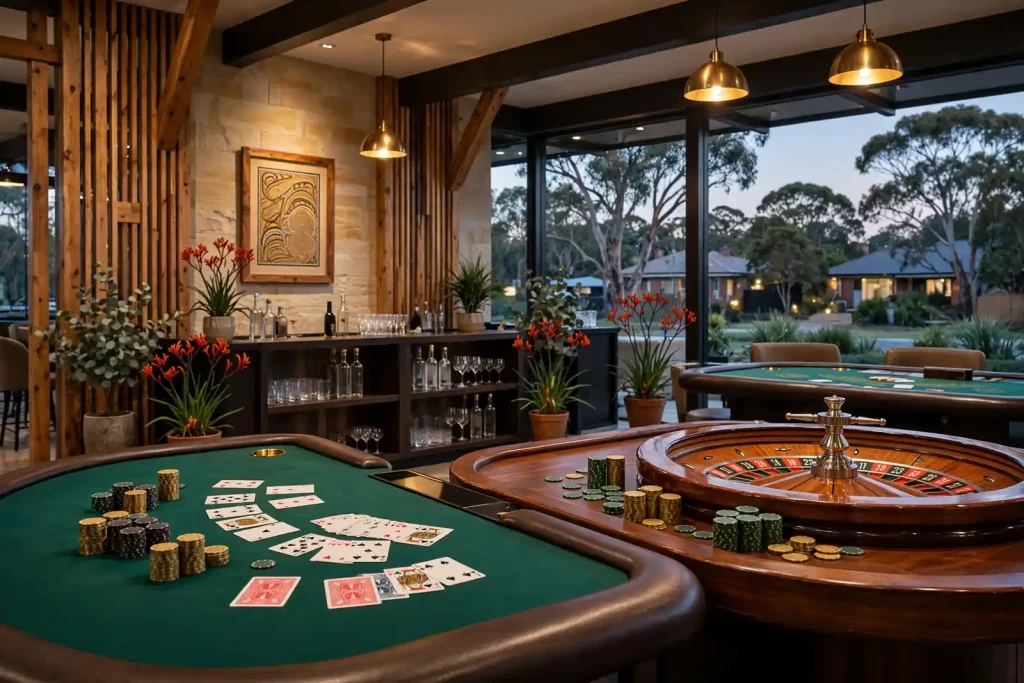
Real-money casino table games in Australia: rules

Pokies Tips and Tricks: What Players Can Control