
Casino Dice Games in Australia: Rules and Legal Context
 Available in AU

Content
Learn how casino dice games work, what sets craps apart, and how Australian law treats real-money online casino services.
Casino Dice Online: The Australian Legal Context
The key legal distinction is between a person playing and a business providing the game. Under Australia’s Interactive Gambling Act 2001, operators cannot provide real-money online casino games to people who are physically in Australia. That restriction covers casino-style services such as blackjack, roulette, poker and slots. An online dice game offered as a real-money casino service sits within that same prohibited category.
The rule is about where the customer is, not just where a website is based. A service does not become lawful for Australian customers simply because its operator is overseas or holds a licence elsewhere. Offshore casinos may accept Australian payments and operate under foreign licences, but those facts do not authorise them to provide prohibited online casino services here.
That is the part that can be easy to miss when a site loads or a payment method appears to work. Technical access and legal permission are different things. A page appearing on your screen does not mean the service is permitted to offer real-money casino games to people in Australia.
When looking for casino dice games in Australia in 2026, check what is known about each operator before deciding where to play. This list provides a concise reference to the available licensing and payment details; it does not confirm that a particular dice game is offered.
1. LuckyVibe
License: Curacao Gaming Control Board OGL/2023/176/0095 (Hollycorn N.V.)
You can note LuckyVibe’s listed Curacao Gaming Control Board licence, OGL/2023/176/0095, held by Hollycorn N.V.
2. JeetCity Casino
License: Curacao eGaming (Dama N.V.)
For your reference, JeetCity Casino is listed with a Curacao eGaming licence held by Dama N.V.
3. DragonSlots Casino
License: Curacao Gaming Authority (Jumpman Gaming Ltd)
You can note DragonSlots Casino’s listed Curacao Gaming Authority licence, held by Jumpman Gaming Ltd.
4. WinSpirit Casino
License: Curacao eGaming OGL/2024/923/0383 (Antillephone N.V.) · Min. deposit: A$30
WinSpirit Casino is listed with Curacao eGaming licence OGL/2024/923/0383, held by Antillephone N.V.; its minimum deposit is A$30.
5. Roby Casino
License: Curacao eGaming (Roby Games Ltd)
For your reference, Roby Casino is listed with a Curacao eGaming licence held by Roby Games Ltd.
6. Playfina Casino
License: Curacao eGaming (Hollycorn N.V., since 2017) · Min. deposit: A$20-30 (depends on the offer)
You can note Playfina Casino’s Curacao eGaming licence, held by Hollycorn N.V. since 2017; its minimum deposit is A$20–30, depending on the offer.
7. House of Pokies
License: international iGaming licence – jurisdiction not named in the source · Payout speed: PayID 1-24 hours · Min. deposit: A$30 (PayID from A$10)
House of Pokies lists an international iGaming licence, but the source does not name the jurisdiction. You can also note PayID payouts of 1–24 hours and a minimum deposit of A$30, or A$10 with PayID.
8. 7Bit Casino
License: Curacao, operated by Dama N.V.
You can note that 7Bit Casino is operated by Dama N.V. and is listed as licensed in Curacao.
9. JustCasino
License: Curacao Gaming Control Board
For your reference, JustCasino is listed with a Curacao Gaming Control Board licence.
10. Ricky Casino
Payout speed: crypto under 1 hour, PayID 1-3 business days · Min. deposit: A$20 (A$30 to qualify for the bonus)
Ricky Casino lists crypto payouts under 1 hour and PayID payouts in 1–3 business days. You can note its A$20 minimum deposit, with A$30 required to qualify for the bonus.
What the law restricts
The Interactive Gambling Act 2001 restricts operators from providing real-money online casino games to people physically located in Australia. Casino dice offered for money online is therefore not a lawful Australian online-casino product. The same applies to online casino games more broadly, whether the site presents them as a familiar table game or uses a different format.
The restriction concerns the operator’s conduct. It is not a general criminal offence for an individual to use an offshore casino, and Australian players are not criminalised simply for playing on such a site. That distinction matters, but it is not an endorsement or a sign that the service is lawful. The operator can still be acting unlawfully by supplying the service to people in Australia.
The Act carries substantial daily maximum penalties for individuals and companies that violate it: up to $360,000 for an individual and $1.8 million for a body corporate. Those penalties concern the people or businesses responsible for the breach, not a player merely using an offshore site.
So, if you are trying to understand whether a real-money online dice casino is permitted here, focus on the service being offered to Australian customers. A foreign licence, Australian-facing payment option or polished local-looking website does not change the basic restriction.
ACMA and access blocking
The Australian Communications and Media Authority, usually called ACMA, is the federal body that enforces the Interactive Gambling Act and monitors compliance with federal interactive gambling laws. It can ask Australian internet service providers to block websites that provide prohibited interactive gambling services or advertise them in Australia.
Slots & Games for Australian Casino Players · 5-Reel Slots in Australia: How They Work
Blocking is one part of enforcement, not a stamp of approval for everything that remains accessible. A site may be unavailable because access has been blocked; another may still appear reachable at a particular time. Neither situation changes the law governing the service. Access can vary, while the prohibition on operators providing real-money online casino games to people in Australia remains.
ACMA reports that it has blocked more than 1,455 illegal gambling and affiliate websites since enforcement actions began in November 2019. This is a cumulative enforcement figure, not a count of dice sites alone. It also shows why a website disappearing, changing address or becoming difficult to access should not be mistaken for a game-specific rule: blocking applies to prohibited services and related advertising, not to the mechanics of one particular casino game.
There is a reported disagreement over the number of illegal services that have withdrawn from the Australian market since ACMA began enforcing the rules in 2017. One count puts the figure above 210; another says more than 190. Both describe enforcement outcomes across illegal services, rather than a separate measure for online dice games.
Advertising is restricted too
The legal framework also matters before anyone reaches a game page. Advertising real-money interactive gambling services, including online casinos, to Australian audiences is banned. That includes promotions for prohibited online casino services; an advertisement does not become acceptable just because it avoids explaining how to play or does not show a particular game in detail.
Marketing can be aimed at the country even when the business is offshore, but that does not make the underlying offer lawful.
This is why a local-language promotion or an Australian payment reference should not be read as evidence that an online casino is authorised to serve Australians. Marketing can be aimed at the country even when the business is offshore, but that does not make the underlying offer lawful. ACMA’s ability to seek blocks for websites advertising prohibited services is part of the same enforcement picture.
There is a useful practical distinction here: information about the law is not an invitation to gamble, and describing the legal position does not make an offshore casino an option to choose. For a reader looking up casino dice online, the relevant point is that real-money casino services cannot lawfully be supplied to people located in Australia, and advertising those services to an Australian audience is also prohibited.
Location, not the name of the game
A dice game does not escape the restriction because it is labelled as entertainment, a casual game or a different kind of online product. What matters for this legal question is whether an operator is providing a real-money casino service to someone in Australia. If money is involved and the service is an online casino game, the Australian restriction applies.
Nor does the wording used on a website settle the issue. A site might describe a product as a dice experience rather than a casino game, but a marketing label cannot override the substance of the service. Equally, not every digital game that happens to depict dice is automatically a real-money casino service. The legal distinction is about the kind of service being provided, including whether it is a real-money online casino offering.
Crash Casino Games in Australia: Formats and Checks · Seven-Reel Slots in Australia: Rules and Free Play
For you, the reliable takeaway is narrower than a general claim that all dice games are unlawful. The restriction concerns operators providing real-money online casino games to people physically in Australia. It does not establish a ban on every game involving dice, regardless of whether money or a casino service is involved.
What this means for players
Australian players are not criminalised simply for using offshore online casinos. That does not remove the risks of using a service that is not permitted to provide real-money casino games here. The law’s focus on operators can make the situation sound simpler than it feels in practice: a player may not face criminal liability merely for playing, while the site itself may still be unlawfully supplying the service.
A foreign licence should be understood in that context. It may relate to the operator’s standing under another jurisdiction’s rules, but it is not an Australian authorisation to provide online casino games to people here. The Australian restriction remains, and ACMA can take enforcement action, including seeking website blocks.
Age is another basic boundary: gambling is for adults aged 18 or older. That does not make an otherwise prohibited online casino service lawful, and it does not change the restriction on operators. It is simply a separate minimum safeguard that applies to gambling participation.
There is also the human cost to keep in view. Gambling can cause serious harm, particularly to vulnerable people. That is not just a legal footnote. A game’s appearance, pace or presentation cannot make financial risk disappear, and nobody should treat gambling as a way to earn income or recover losses.
Legal Risk
Australian players are not criminalised for playing on offshore sites, but the operators providing these services to Australians are acting unlawfully.
Reading the Australian position clearly
If you see a real-money casino dice offer presented to Australians, separate three questions: what the service is, who is supplying it, and where the customer is located. The law restricts the operator from providing online casino games for money to someone physically in Australia. An offshore address or foreign licence does not reverse that rule. A blocked or reachable website does not determine whether the offer is lawful. And the player’s lack of criminal liability does not make the operator’s service legal.
That is the legal context for casino dice online in Australia. It is about the boundary on real-money online casino services and their advertising, plus the regulator’s role in enforcing that boundary.
How to Play Casino Dice Online
If you are learning casino dice, start with the instructions for the particular game rather than assuming that every game using dice works the same way. The name alone does not tell you what you must do, what outcomes count, or how a round ends. Those details belong to the game’s own rules.
Pokie Machines to Play in Australia: Legal Guide · Progressive Jackpot Slots: How They Work and Pay
I would read those rules before touching a wager button. Look for the objective, the choices available to you, how an outcome is settled and what happens when a round is complete. Then check the terms used on the screen against the written instructions. If a label is unclear, pause and find its definition; guessing at a control is a poor substitute for knowing what it does.
A sensible learning order
You can approach an unfamiliar game in a few passes:
- Read the objective first. Work out what the game asks you to do, without trying to memorise every detail at once.
- Find the decision points. Note when the game asks you to choose or confirm something, and what the instructions say each choice means.
- Check how results are described. Make sure you understand how the game identifies a successful or unsuccessful outcome and settles the round.
- Review the full rules again. Once the terms make sense, reread the instructions from start to finish. Small conditions are easy to miss on a first pass.
That is a way to study the rules, not a set of universal casino dice instructions. The steps within a round depend on the specific game, and it would be misleading to supply one sequence as if it applied to all of them.
If a game offers a demonstration or other non-monetary practice mode, treat it as a way to learn the interface, not proof that you understand every condition. Check whether its instructions match the version you are studying. Do not assume that a practice screen has the same settings or settlement details as any other version. And do not mistake a button’s presence for an explanation of what it does.
Before you begin
A quick check can save confusion: can you explain the objective in your own words? Do you know what choices the game gives you? Can you tell how the instructions say a round is settled? If not, go back to the rules. If the rules do not answer a question, do not fill the gap with a guess.
Before You Begin
- Can you explain the objective in your own words?
- Do you know what choices the game gives you?
- Can you tell how the instructions say a round is settled?
Keep learning separate from spending. This page is not a recommendation to use an online casino or to place real-money wagers. Anyone considering gambling must be at least eighteen, and gambling can cause serious harm, particularly for people who are vulnerable. A game should not be treated as a way to earn income or recover money already lost.
For Australians, the phrase “play online” also needs care: learning how a game is described is different from seeking a real-money casino service. A free-play label does not, by itself, explain what service is being offered or make every site suitable. Focus on understanding the game’s own published instructions, and do not take this guide as a route to an online casino.
When you look up how to play casino dice, the useful answer is not a made-up universal recipe. It is a clear explanation tied to one named game, with its own rules and interface. Read those rules slowly, check that you understand each decision, and stop if anything remains unclear. Better a pause than a guess.
Casino Games That Use Dice
Dice can appear in a casino game in different roles, so the phrase “a game with dice” does not identify one particular format. In one game, the dice may be the central feature: their result is what the game revolves around. In another, they may be only one element among several. That distinction is more useful than assuming every casino table game with dice works in the same way.
Mines Casino Game in Australia: What to Check · Live Roulette in Australia with English-Speaking Dealers
When I’m sorting out what a game description means, I look first at how prominently it presents the dice. Are they the defining feature, or are they mentioned alongside other components? A game built around dice belongs in the first broad category. A game that happens to include dice may belong in the second. The wording matters, because the presence of dice alone tells you little about the overall format.
Why the number of dice is not a game name
People often narrow their search by asking about a casino game with two dice or three. That gives you a count, not a reliable identification. The number of dice does not, by itself, tell you what outcomes matter, how a round is structured or what other parts the game may use. Those details depend on the individual game.
So if a description says that a game uses two dice, treat that as one piece of information rather than a complete explanation. The same goes for three dice. A matching count is not enough to conclude that two games share the same rules or even the same kind of play. It is a simple label, not a shortcut through the game’s full description.
This is where broad categories can help without pretending to settle the details. You can distinguish dice-centred games from games where dice are a secondary feature, then use the game’s own description to understand what else is involved. I would not choose a game based on the number of dice alone. Too little to go on.
Dice-centred Games
Games where the dice are the defining feature and the results revolve around them.
Dice as Secondary Feature
Games where dice are included as one element among several within a wider format.
Table games and other formats
“Casino table game” describes a setting or presentation, not a single set of mechanics. A table game may use dice, but that does not make all dice-based table games interchangeable. The dice might be the main focus, or they might sit within a wider game format. The label tells you to expect a table-style presentation; it does not explain what a player does or how a result is determined.
That distinction also keeps the category open. A list headed “casino games played with dice” would need named, confirmed examples to be useful. Without checking a particular game’s description, it is more accurate to talk about the broad types than to attach familiar names to a category and imply that they all fit in the same way.
The practical takeaway is straightforward: identify whether dice are central or incidental, and treat the stated number of dice as a descriptive detail. Neither clue substitutes for the game’s own explanation. A shared piece of equipment does not make shared rules.
Craps and the Dice on Its Table
Craps is commonly discussed as a casino dice game, but the name alone does not tell you what a particular table looks like or how a session works. If you are trying to picture the setting, keep the distinction clear: “craps table” names the game’s table context; it is not a reliable description of its layout, equipment or procedures.
The dice are part of what people have in mind when they talk about casino craps. That still leaves practical details open. A label such as “casino dice” does not, by itself, establish the dice’s material, dimensions, markings, handling or inspection process. Nor does a photograph tell you whether the pictured equipment is used in the game being described. Those details need to come from a specific, accountable description—not from the word craps.
Live Blackjack Online in Australia: Rules and Limits
What “the table” tells you
A table reference can help separate craps from a general mention of dice, but it is not a set of instructions. It does not establish where a player stands, how many people can take part, what happens at each stage or which bets are available. I would not treat a familiar-looking image, a game title or a short promotional description as proof of any of those things.
That matters especially when “real casino dice” appears in a description. Real can mean different things in ordinary conversation: physical dice rather than an animated image, equipment presented as casino-style, or simply a phrase meant to sound reassuring. Unless the provider explains what it means and how the game is conducted, the word does not verify the equipment or the experience. A confident label is not a specification.
The same caution applies to images of a craps table. A picture can create an impression of a particular setup without explaining whether it reflects the actual game. If a description makes claims about dice or table equipment, look for clear details tied to that game rather than assuming that all craps tables share the same arrangement.
Reading a description carefully
When you encounter a reference to craps dice, separate what is stated from what you are filling in yourself. Does the description identify the game and explain its presentation? Does it say whether the dice shown are physical or digitally represented? Does it describe the table context, or merely use a familiar table image? If those points are not addressed, the label alone cannot answer them.
Understanding Craps Descriptions
Unless the provider explains exactly how the game is conducted, a label like “real casino dice” or a simple image does not verify the actual equipment or procedures used.
Specific details about material, dimensions, markings, and handling must come from an accountable description rather than just the name of the game.
This is not a guide to craps rules, and the phrase “craps table dice” should not be mistaken for a complete explanation of play. It points to a topic, not a full account of how a game operates. Keep the terms in proportion: craps identifies the game being discussed; dice and table refer to parts of its casino presentation. The fine print matters.
Casino Dice Rules and What Makes a Game Suitable
A set of casino dice rules should tell you what counts as a result and how that result affects the round. The wording needs to be clear before anyone places a wager: a rule you have to guess at is not a useful rule.
When reading a game’s rules, look for the parts that determine how play is settled:
- The objective: what outcome the game asks you to predict or achieve.
- The result: how the dice outcome is interpreted, including any combinations that matter.
- The round structure: when a round begins and ends, and what happens if play is interrupted.
- The wager and payout terms: which choices are available and how a winning or losing result is settled.
- Exceptions: how the rules handle ties, invalid rolls or other unusual situations.
Those are questions for the rulebook, not assumptions to import from another dice game. A familiar name does not guarantee familiar mechanics. If a description skips a condition that could change the result, treat that as a reason to pause rather than filling in the blank yourself.
“Best” is a matter of fit, not a universal ranking. One person may value short, uncomplicated rules; another may prefer a game with more choices to understand. You can compare clarity, how much information is provided before play, and whether the stated terms are internally consistent. Avoid judging suitability by a bold payout claim alone: the rules explain what must happen for that claim to apply.
I would also separate a game’s presentation from its rules. A polished table or lively dealer does not make unclear terms clearer. Read the written rules and any payout information together, and check that the same terms appear wherever the game is described. If they conflict, do not rely on the more attractive version.
Video Slots in Australia: Rules, RTP and Free Spins · Pokies Tips and Tricks: What Players Can Control
For Australian readers, this is a rules-literacy point, not an invitation to seek out real-money online casino play. Australian law prohibits operators from providing online casino games for money to people in the country. And gambling can cause serious harm, particularly for vulnerable people; no game’s presentation or rule set removes that risk.
A suitable game, in the broad sense, is one whose terms you can understand without guessing and whose risks you can recognise. If you cannot explain how a result is settled after reading the rules, the sensible move is to leave it there. Clear terms matter.
What Counts as a Casino Dice Game?
A casino dice game is a gambling game in which dice have a meaningful part in determining the result. The key point is not whether dice appear on the screen, in the name or in the artwork. It is whether the game’s outcome depends on a dice result, rather than dice being decorative.
Genuine Dice Games
A game is a dice game if the outcome depends on a dice result, not if dice are merely decorative.
That gives you a useful way to separate a genuine dice game from a casino game that merely borrows the look. If dice are only an animation layered over some other outcome system, calling it a dice game may be more about presentation than substance. If the result is tied to dice, the description fits at a broad level.
The label does not, by itself, tell you what the rules are, how many dice are involved, or what choices a player can make. Those details belong to the individual game. Two games can both use dice and still feel quite different; the shared equipment does not make their rules interchangeable. I’d treat “dice game” as a category, not a promise that you already know how a particular title works.
Nor does the label tell you whether a game is offered in a physical venue, through software, or in a live presentation. Those are separate questions about where and how it is provided. Here, the simplest test is the role of the dice in producing the game’s result.
So, when you see a casino title described as a dice game, look past the label and check what the game says actually determines an outcome. If dice are central to that process, the description makes sense. If they are just visual dressing, it is a looser use of the term. A small distinction, but a useful one.
Live Baccarat Online in Australia: Legal Guide · Lightning Link Online Pokies in Australia: The Facts
This is a definition, not an invitation to play. Gambling is for adults aged 18 or older, and it can cause serious harm, particularly for people who are vulnerable.
Dice-Game Strategy and Risk
When people talk about strategy in a casino dice game, they often mean choosing how to stake, not finding a way to control the dice. Those are different things. A plan can keep your decisions consistent; it cannot make a roll land the way you want.
I’d start by separating what you can decide from what you can’t. You can decide whether to take part, how much you are prepared to lose, and when to stop. You cannot rely on a previous result to predict the next one, or treat a run of wins or losses as a signal that a reversal is due. That kind of reasoning feels persuasive at the table. It isn’t a dependable edge.
Before you play, set a spending limit that you can afford to lose and a stopping point. Keep gambling money separate from bills and other essentials. If you reach either limit, stop rather than trying to recover what has gone. Chasing losses can turn a short session into a much larger problem.
Be wary of systems sold as guaranteed ways to win, including advice to increase stakes after a loss or keep playing until a target is reached. A staking pattern does not remove the risk of losing. If you cannot explain what a proposed strategy changes — and what it does not — treat the claim with caution.
Do
- Set a spending limit you can afford to lose
- Set a stopping point for your session
- Keep gambling money separate from essentials
Don’t
- Chase losses to try and recover money
- Rely on previous results to predict the next roll
- Follow systems that guarantee a way to win
Also check the terms of the game before committing money. Do not assume that similar-looking dice games have the same conditions, or that a strategy discussed for one applies to another. I would not judge a game by a confident-sounding tip alone.
Casino gambling is for adults aged eighteen or over, and it should not be treated as income. Gambling can cause serious harm, particularly for people who are vulnerable or already struggling to control their play. If it is affecting your finances, relationships or wellbeing, step away and seek support rather than looking for a stronger system. There is no clever betting pattern that makes risk disappear.
Live Casino Dice: What the Format Means
“Live” describes how a casino game is presented, not what the dice rules are. When people refer to live casino dice, they generally mean a format presented as unfolding in real time, rather than a game that simply displays a result on screen. The label alone does not tell you how a round works, who or what controls the dice, or what choices a player has.
3-Reel Slots in Australia: Features, RTP and Play · Best RTP Slots in Australia: How to Read RTP
That distinction matters. A live presentation is not a separate set of dice rules, and it does not make an unfamiliar game easier to assess. You still need to understand what determines a result and what each decision means before you can judge whether the game suits you. Don’t infer those details from the word “live”.
In Australia, the format label also changes nothing about the legal position. The Interactive Gambling Act 2001 prohibits operators from providing real-money online casino games to people physically located in Australia. That includes casino-style games whether they are presented live or in another online format. ACMA can ask internet providers to block access to sites offering prohibited services.
So, if you encounter the phrase “live casino dice”, read it as a description of presentation, not proof that a particular game or service is available to Australian players, or that it has been approved locally. A polished stream is still just a presentation. The rules and the legal setting are separate matters.
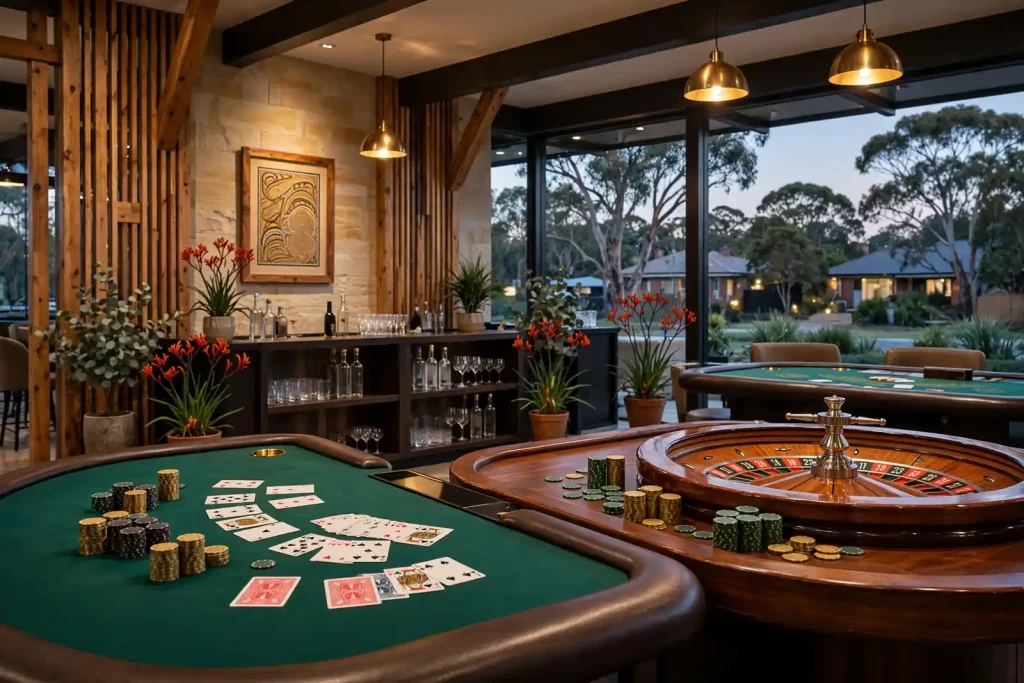
Real-money casino table games in Australia: rules
Where You Roll the Dice in a Casino Game
When someone asks for a casino game where they roll or throw the dice, they may mean a game in which the player appears to initiate the roll. That is different from simply watching dice determine an outcome: the visible action can be part of the experience, but it does not tell you who controls the result or how the game works.
In a digital presentation, “rolling” may describe an action shown on screen rather than a physical throw. Without the game’s rules and description, the label alone cannot establish whether you make a meaningful choice, when an outcome is determined, or what the dice are used for. I would look for those details before treating the animation as anything more than presentation.
There is also a practical distinction between playing with physical dice and viewing a digital game. In a physical setting, you can see the dice being handled; in a digital one, the screen represents the action. Neither description, by itself, tells you the odds, the rules or whether a particular game is appropriate for you. Don’t infer those from the word “roll”.
For Australians, the legal setting matters too. The Interactive Gambling Act 2001 prohibits operators from providing real-money online casino games to people in Australia. That includes casino-style games offered online, whether the screen shows dice or another kind of play. ACMA can also seek to block access to prohibited services. A familiar-looking interface does not change that.
So, if you mean a game in which you personally make a throwing motion, check whether that is literal or merely visual, and read the game’s description rather than relying on its title. For real-money online casino play, Australians should not treat an offshore site or its dice animation as a lawful local option. Dice on screen are not a legal loophole.
Related posts
Real-money casino table games in Australia: rules

Pokies Tips and Tricks: What Players Can Control